-
1. The amount of text in each lesson is controlled.
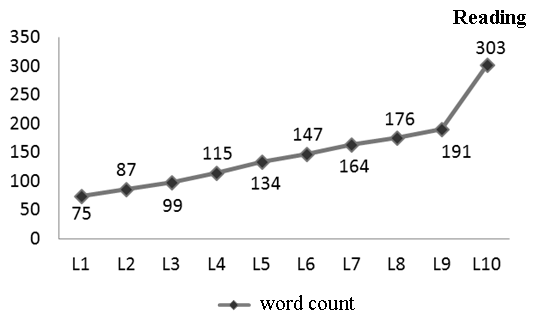
The amount of text usually increases by only 10 to 20 words from lesson to lesson. Thus, the students can take small steps towards improving their reading skills. And since the number of words always goes up from lesson 1 to lesson 10, the students can feel a sense of accomplishment.
-
2. The four warm-up lessons at the front of the book
Focus on Phonics (sound-letter association)
- Warm-up 1 - Long and short vowels
- Warm-up 2 - Consonants (Group 1)
- Warm-up 3 - Consonants (Group 2)
- Warm-up 4 - Consonants (Group 3)
Focus on Communication
- Warm-up 1 - Hi, I’m ~. Nice to meet you ~.
- Warm-up 2 - What kind of ~ do you like?
- Warm-up 3 - Do you like ~?
- Warm-up 4 - Can you...?
-
3. Warm-up activities in lessons 1 - 10 (two-page spread)
As with the four warm-ups at the start of the textbook, the warm-up activities in each lesson start with pronunciation practice of basic vowel and consonant sounds. These sounds are often embedded in the names of people (for example, the names in the warm-up of lesson 3 target the consonants T/D, P/B, and K/G). Play the class CD and have the students repeat.
-
4. Comprehension questions
Each part of the text has one comprehension question. Additional comprehension questions can be found in the teachers’ manual and student workbook. This will require less preparation time from the teacher. In lessons 1 - 3, the comprehension questions are written in Japanese. From lesson 4, they are written in English.
-
5. Expression and Communication
There are many pair work, group work, and class activities in this textbook, giving students lots of opportunities to communicate with each other and express themselves. These activities can also be done with the ALT.